
Project GO

Precision Agriculture

Lesson Plan Two: Using GIS Information to Make Farming Decisions

Overview: Students will make recommendations about corn planting rates in fields owned by Don Villwock, the farmer they met in the video seen in the previous lesson. Students begin by interpreting a soil map for these fields. They then examine the characteristics of the soils shown on that map and recommend which soil zone of the fields should be planted at the lowest application rate based on their review of the characteristics of soils in the fields. Finally, they compare their recommendation to a planting map for those fields.

Estimated Time: 40-50 minutes each for the opening, developing, and conclusion of the lesson. These can be taught in separate class periods.

Materials:
Worksheet 1: Interpreting a Soil Map
Worksheet 2: Soil Characteristics
Worksheet 3: Vocabulary List
Worksheet 4: Planting Map
Map: Soil Map
Map: Planting Map
Overhead projector and/or document camera

Learning Objectives: After completing the lesson, students will be able to:

  1. Interpret and systematically compare maps
  2. Describe how variable rate technology works in corn planting
  3. Examine the characteristics of soils to estimate growing capabilities (productivity)

Vocabulary:

Drought: A long period of abnormally low rainfall.

GIS: A geographic information system (GIS) is a system designed to capture, store, manipulate, analyze, manage, and present spatial or geographic data.

Hybrid Corn: A combination of two or more varieties of corn.

Loam: Soil with roughly equal proportions of sand, silt, and clay.

Permeable: A material, for example soil, that allows liquids, for example water, to pass through it.

Run off: The draining away of water (or substances carried in it) from the surface of an area of land, a building or structure, etc.

Tilth: The condition of tilled soil, especially in respect to suitability for sowing seeds.

Variable rate technology: Allows crop producers to apply different rates of seeds, for example, at each location across fields. The technology needed to accomplish variable application rate.

GIS Tools and Functions: N/A

  • Use GIS paper maps to read a map (symbols, scale, direction)
  • Use GIS maps to interpret patterns

Additional Resources: N/A
Opening the lesson: “Remember Don Villwock, the farmer we met in the previous lesson? He used variable rate planting technology which means, for example, that he is able to vary the rateMATHEMATICS: Rate is the ratio between two related quantities, for example, miles per hour at which he plants seeds as his tractor and planter move across a field. The equipment needed to do this includes planting equipment capable of changing rates as it crosses a field and a Global Positioning System (GPS)Global Positioning System (GPS) is a radio navigation system that allows land, sea, and airborne users to determine their exact location, velocity, and time 24 hours a day, in all weather conditions, anywhere in the world.. It also includes an in-cab computer and software containing a field zone application map.

“Your task is to help prepareProblem-based learning lessons give students a real-world problem with real data for which they must find a solution. the application map that Don will use to plant corn in two fields next season. With the rising cost of corn seed, Don is very interested in reducing seeding rates in areas that are likely to be least productive.”

  1. Distribute a copy of the Interpreting a Soil Map handout to each student. As a classIf you have completed the Urban Heat Island Module prior to this module, you may have your students work in groups to complete the handout. If you have not, this is an opportunity to model for the class how to interpret a map., interpret the Soil Map that appears in the handout. Follow the three- step map interpretation procedure outlined in the handout. (What is the map about? What does the map say? What does the map mean?) Display the handout and soil map on the overhead projector and/or document camera so you can fill in the answers as students follow along.
  2. Begin by reading from the top of the handout. “Important information about soil zones can be obtained from soil maps. Before the information on a map can be described and analyzed, the first step is to have a clear understanding of what the map is about.

    Question One, what is the map about? To answer this question you have to preview the map. Let’s look at these five items: title, symbols, map scale, compass direction, and footnotes, and identify them in a way to understand the map.

    “What is the title of this map?”

    “Titles are usually found at the top of a map (point to an example in the classroom if you have a map hanging). The title of this map is “soil map.” Based on this title we know that this map is going to be a soil map.

    “Next we are going to decode the symbols. In order to decode symbols, we have to look for a key or legend. Where is the legend on this map? It is this section on the bottom that shows Map Unit Symbols (MUSYM). In the legend we see four map unit symbols that represent a different soil type with a description about eachAs you go over each of the four soils locate them on the soil map..

    The light green, identified as Ay, is a soil called Ayrshire fine sandy loam. The drainage class is somewhat poorly, the soil texture is fine-loamy and there are a total of 52.8 acres of this soil represented on the map or 49.7 percent.

    Yellow, identified as Ls, is a soil called Lyles fine sandy loam with a poorly drained drainage class and coarse-loamy soil texture. The Lyles fine sandy loam accounts for 27.7 acres or 26 percent on the map.

    The red, or Ly, is a soil called Lyles loam with a poorly drained drainage class and fine-loamy soil texture. It covers 24.7 acres or 23.2 percent of the land on the map.

    Lastly, the orange or BIB, is called a Bloomfield loamy fine sand soil. It is classified as somewhat excessively in the drainage class, has a sandy soil texture and there is only one acre, or one percent, of this soil type represented on the soil map.

    “The symbols represent nominalMATH: There are four types of measurement scales: nominal, ordinal, interval, and ratio. data, which do not represent numbers but variables, for example, male or female.

    “Next, we are going to check the map scale. This tells us the relation between distance on the map and the actual distance on the ground. If we take out our rulers we can see that one inch on the map represents 800 feet on the ground.

    “Next, we are going to use the direction indicator or compass to find northThe cardinal directions are North, South, East and West. Knowing these and being aware of which way is north is important when you are going from place A to place B and are following a set of directions.. This shows us that north is facing up. But, North is not always facing up on maps. Knowing the cardinal directions can also help in describing spatial relationships* Describing spatial relationships is important when talking about an area and features. It gives greater detail than simply saying left or right. Descriptive words include: above, along, apart, around, behind, below, beside, bottom, buffer, center, clustered, connected, distributed, down, far, inside, intersect, isolated, next, outside, over, parallel, patterned, peripheral, random tangent, top, towards, under, up. of locations and features. For example, Bloomfield loamy fine sand soil is located on the southern part of the soil map, and west of some Lyles loam soil.

    “Lastly, let’s look to see if there are any footnotes or additional information about the map that would help us understand what this map is about. The footnote shows that this data and map was prepared on October 28, 2015 at 8:04pm by someone named Betsy Bower.

    “Additional information on this map is located in the top right corner. In this box we see some important facts, such as the name of the grower, Don Villwock; the name of the farm, Slinkard; the size of the farm is 106.2 acres pictured on the map; the field name is 1 and 5 combined; the field size is 106.2 acres; and the crop being grown there is corn.

    “Let’s move on to Question Two. What does the map say? The second step in obtaining information from a map involves asking and answering questions about how things are arranged on the map.

    Ask and answer ‘fact finder’ questions. Some questions are asked to find facts that are important. Answering ‘fact finders’ supplies you with basic information about the features on the map.

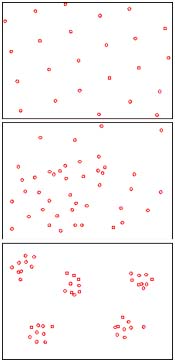
    Ask and answer ‘pattern finder’ questions. Pattern finders ask how things are arranged over the map. A basic distinction is made among clustered, random, and uniform arrangementsUniform (top) Random (middle) Clustered (bottom)1

    Uniform Random Clustered Arrangement1 https://en.wikipedia.org/wiki/Species_distribution
    . With clustered arrangements, objects are located close together. With uniform arrangement, objects are evenly spread over an area. With random arrangements, there is no pattern to how objects are arranged. Answering pattern finders supplies you with information about the arrangement of features on the map.

    “We are now going to examine the Soil Map and determine how the features on the map are arranged by answering the following questions.

    “How many different soils appear on the map? (Fact Finder)

    “Are particular soils clustered, randomly or uniformly distributed? Explain. (Pattern Finder)

    “What characteristics do the soils in these two fields have in common? (Fact Finder)

    Question Three asks what the map means. We need to take the information we gathered in question one and two, analyze it and combine it into a brief, well- organized summary. This summary should consist of five to six sentences that draw together the information obtained from the map.

  1. Ask some students to share their responses with the class. Encourage other students to ask questions.

Developing the Lesson:

  1. Distribute a copy of the Soil Characteristics handout to each student. Students will work in groups of three or four to complete the activity described in the handout.
  2. Distribute the Vocabulary List handout so students can refer to it.
  3. Once students are in their groups, start reading the worksheet out loud.

    “In this activity you will be examining certain characteristics of the four different soils that appear on the Soil Map. Your task is to determine which soil is least likely to produce high corn yields.

    “In order to do this, you will be examining four characteristics of the soils—soil texture, drainage class, available water capacity, and slope—in Don’s fields which will help you determine which soil will be least productive. Below is an explanation of the four characteristics that will help you make your final decision. Use the Summary Table at the end of the Soil Characteristics handout to keep track of your findings.

  4. Let the students work in their groups to complete the Summary Table. Be available to answer questions, and walk around the class to check on each group.
  5. Once students have identified the characteristics of the soils in the two fields, have them identify the soil zone that is likely to be least productive based on their analysis.
  6. For homework, ask each student to write a short statement identifying the soil selected as least productive, explaining why they selected it in terms of drainage class, slope, available water capacity, and soil texture. This soil zone will be their recommendationOn the board, the next day, keep a record of what students’ recommendations are, after completing the Summary Table. for lowest application rate.

Concluding the Lesson:

  1. Distribute a copy of the Planting Map handout to each student. Ask students to work in their small groupsStudents should be able to complete the handout on their own after you modeled how to do it with the Soil Map. of three or four to interpret the Planting Map that appears in the handout by using the three -step map interpretation procedure outlined in the handout.
  2. Then, in their small groups of three or four, ask the groups to compareSpend a few minutes, as a class, to discuss why the soil map and the planting map are comparable. (They both cover the exact same area.) the patterns of the Soil Map and the Planting Map, using the questions on the Planting Map handout as a guide. Have them enter their answers to these questions on the handout.
  3. When the small groups have completed their work on comparing the two maps, ask the students to share what they have learned about the maps as a class.
  4. Once students compare the two maps, update the record on the board about what students think is the least productive soil for planting corn.
  5. Ask students what conclusions they can draw about the relationship between soil zones and seed application rates, based on what they have learned from comparing the maps.
  6. To end the lesson, ask students to brainstorm what other factors, besides the four soil characteristics that they focused on, might influence seed application rates.

Lesson Plan One: What is Precision Agriculture?